

What Makes AI Calls Sound Human? The Technology Behind AI Voice Agents
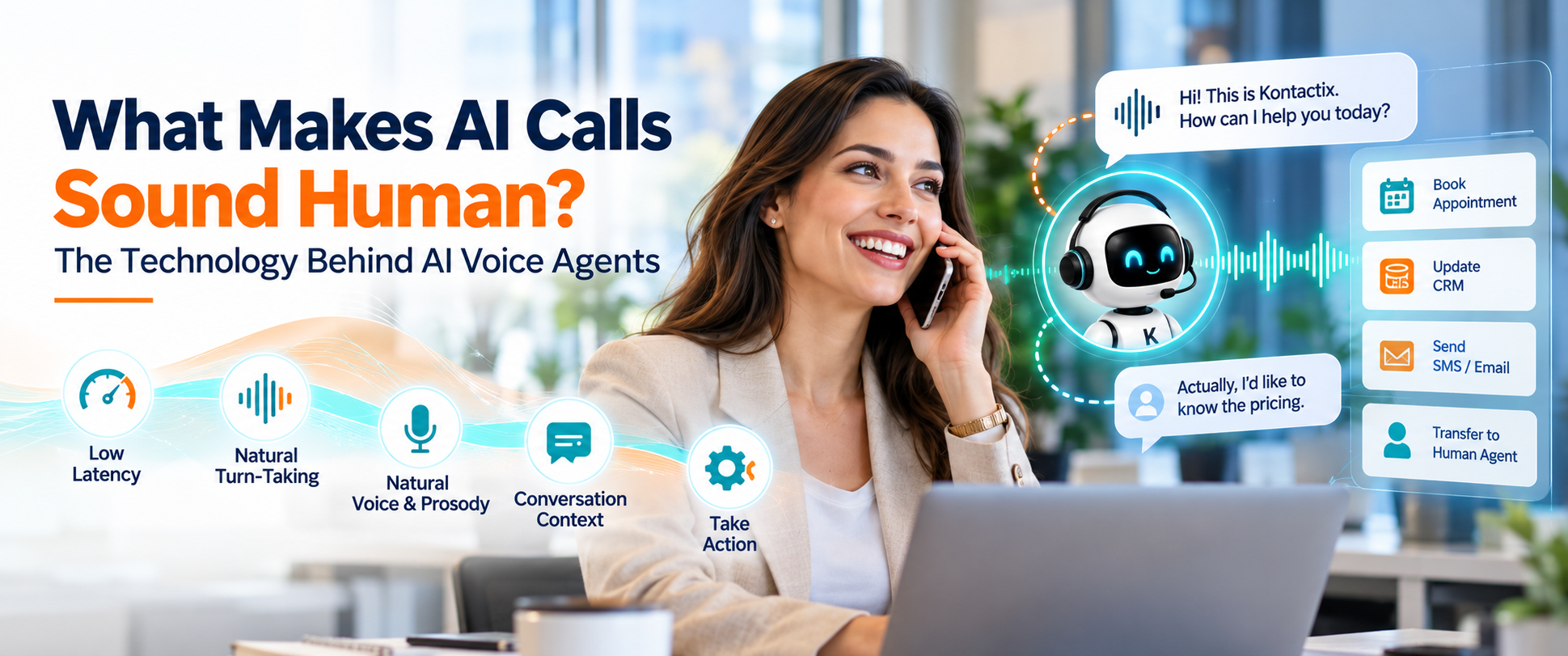
AI voice agents have come a long way from traditional robotic IVR.
Today, a good AI outbound call should do more than produce a realistic voice. It needs to listen, understand, respond quickly, handle interruptions, and maintain context throughout the conversation.
So what actually makes an AI call sound human?
1. Low Latency
One of the biggest differences between natural and robotic conversations is response time.
Traditional voice AI often follows:
Each step can introduce latency.
Modern voice agents increasingly use streaming technologies and speech-to-speech models to reduce this delay. AWS, for example, reports that its Nova 2 Sonic voice-agent implementations can typically achieve under 500 ms end-to-end latency.
For AI outbound calling, even a short delay can make a conversation feel unnatural.
Fast responses make AI feel more conversational.
2. Natural Turn-Taking and Barge-In
Humans don't wait for perfectly completed sentences.
We interrupt, pause, change direction, and sometimes speak at the same time.
AI voice agents need to handle the same behaviors.
Modern systems use Voice Activity Detection (VAD) and turn-detection technology to determine when a customer has finished speaking.
They also support barge-in, allowing the customer to interrupt the AI naturally.
For example:
A good voice agent should immediately stop and answer the question.
This is an important part of making AI outbound calls feel like real conversations rather than scripted IVR flows.
3. More Natural Voice and Prosody
A realistic voice isn't only about pronunciation.
Human speech includes:
These elements are known as prosody.
Newer voice models are increasingly able to adapt these characteristics based on the conversation.
For example, an AI agent may sound more enthusiastic when confirming an appointment and more measured when handling a customer complaint.
The goal isn't simply to sound human.
It's to sound appropriate for the situation.
4. Context and Conversation Memory
A human-like voice means little if the AI forgets what the customer just said.
Consider:
The problem isn't the voice. It's the lack of context.
Modern AI voice agents can maintain conversation history and use customer information such as:
This allows AI to respond based on the whole conversation, rather than simply the last sentence.
5. AI Needs to Take Action
The best AI outbound calls don't stop at conversation.
The AI should be able to turn what the customer says into an action.
For example:
Customer shows interest
This is where AI voice agents become more than voice technology.
They become part of the sales and customer-service workflow.
What About Speech-to-Speech AI?
One of the biggest trends in voice AI is the move from traditional:
toward native Speech-to-Speech (S2S) models.
S2S models process audio more directly and can better preserve conversational characteristics such as tone and prosody. OpenAI's realtime models and Amazon Nova Sonic are examples of this direction.
However, S2S doesn't automatically make every voice agent better.
Cascaded architectures remain useful because they offer more flexibility and allow businesses to independently select their ASR, LLM, and TTS components.
For production AI outbound calling, the right architecture still depends on:
What Really Makes an AI Call Sound Human?
It's not one model or one voice.
It's the combination of:
Fast response
The technology is moving from simply generating human-like voices to conducting human-like conversations.
And for AI outbound calling, that's the real breakthrough.
The future isn't just better AI voices.
It's better AI conversations.

