

0 Introduction: When an AI Call Fails, Where Do You Look?
An AI voice agent calls a customer.
The customer answers, asks a question, and waits.
Three seconds pass.
The AI responds with an irrelevant answer. The customer interrupts, but the AI continues speaking. Eventually, the customer hangs up.
The call recording tells you what happened.
But it doesn't tell you why.
Was the delay caused by the SIP carrier? Network jitter? Speech recognition? A slow LLM response? Or a failed database lookup?
This is where observability becomes essential.
For production Voice AI, observability isn't simply about monitoring whether the system is online. It's about understanding every step of a conversation, identifying where failures occur, and determining what needs to be fixed.
1 Why Traditional Call Center Monitoring Isn't Enough
Traditional contact centers typically monitor metrics such as:
- Call volume and connection rates
- Average handling time (AHT)
- Average speed of answer (ASA)
- Abandoned calls
- Agent performance and customer satisfaction
These metrics remain important for AI contact centers.
However, an AI voice agent introduces additional technical layers.
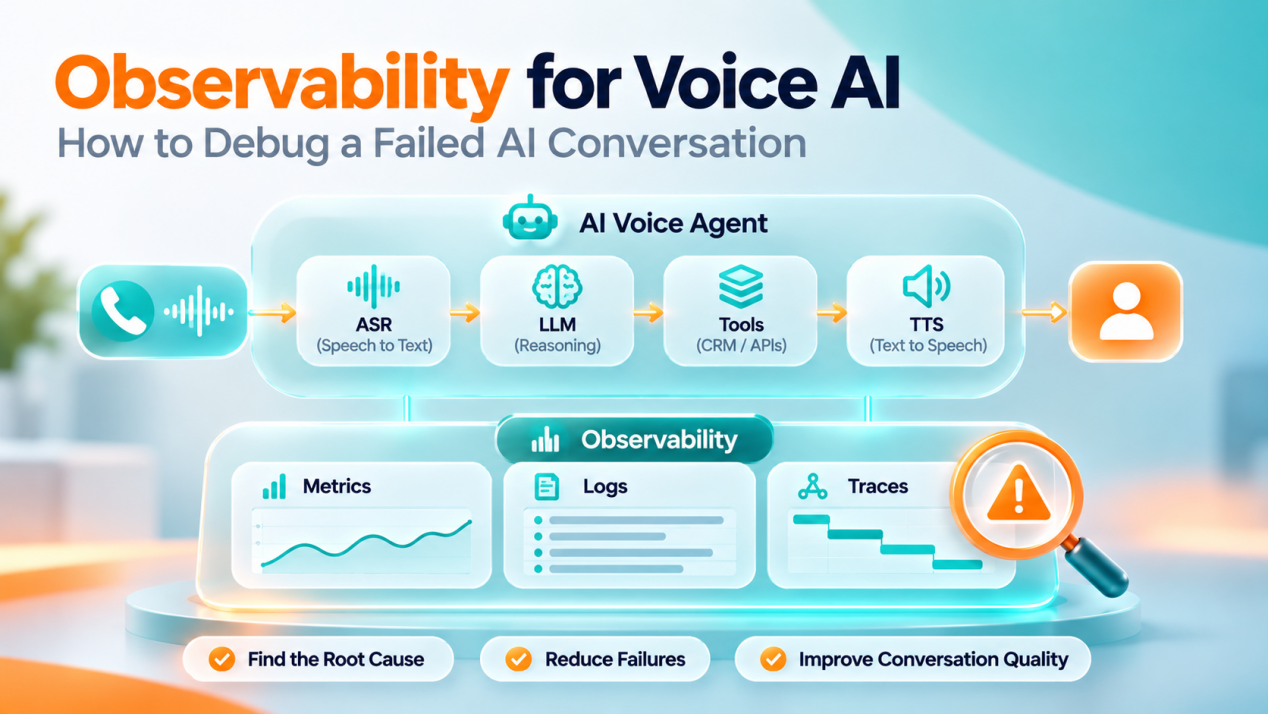
A typical conversation involves:
Conceptual architecture for a cascaded Voice AI system. Speech-to-speech models may combine several processing stages, but still require end-to-end instrumentation.
Each layer can introduce latency, errors, or unexpected behavior.
Without visibility into these components, engineering teams are left guessing.
2 The Three Pillars of Voice AI Observability
A useful observability strategy combines three types of telemetry.
Metrics: Is Something Going Wrong?
Metrics reveal patterns across thousands of calls.
Examples include:
- SIP call setup success rate
- Post-dial delay (PDD)
- Audio packet loss and jitter
- ASR processing latency
- LLM time to first token (TTFT)
- TTS time to first audio
- Tool execution latency
- Human handoff success rate
Metrics help identify where performance is deteriorating.
For example, if LLM response times increase across all campaigns, the issue may involve model capacity or upstream inference services.
If problems occur only on calls routed through one carrier, telephony infrastructure deserves closer investigation.
Logs: What Actually Happened?
Logs record individual events.
A useful Voice AI log might include:
14:32:01.120 CALL_CONNECTED
14:32:04.250 USER_SPEECH_STARTED
14:32:06.180 USER_SPEECH_ENDED
14:32:06.420 ASR_FINALIZED
14:32:06.450 LLM_REQUEST_STARTED
14:32:07.180 LLM_FIRST_TOKEN
14:32:07.210 TTS_REQUEST_STARTED
14:32:07.480 FIRST_AUDIO_SENT
This event sequence makes it possible to reconstruct a conversation at the millisecond level.
The example is illustrative, not a measured production call.
Traces: Where Did the Time Go?
Distributed tracing connects events across multiple services.
A single conversation turn might involve:
Each operation can be represented as a trace span with its own duration, status, and metadata.
OpenTelemetry provides a vendor-neutral framework for collecting traces, metrics, and logs across distributed systems.
Reference: OpenTelemetry — Observability Primer.
3 Debugging Latency: Why Does the AI Respond So Slowly?
Latency is one of the most noticeable problems in AI voice conversations.
Even when an AI agent generates a correct answer, excessive response delays can make the conversation feel unnatural.
However, measuring only the LLM's response time is insufficient.
Consider this hypothetical latency breakdown:
In this example, the LLM accounts for almost half the total response delay.
Optimizing SIP routing would not meaningfully address that particular bottleneck.
But the reverse can also happen.
A fast model cannot compensate for delayed speech detection, network congestion, or excessive audio buffering.
What Should Engineers Measure?
At minimum, track the following timestamps:
For streaming pipelines, stages may overlap. Therefore, adding individual component latencies may overestimate the actual end-to-end delay.
The most reliable metric is the elapsed time between clearly defined conversation events.
4 When the AI Gives the Wrong Answer
Not every failed conversation is a latency problem.
Sometimes the AI responds quickly but incorrectly.
Consider a customer asking:
"Can I reschedule my appointment to Friday?"
The AI responds:
"Your appointment has been successfully rescheduled."
But no appointment was actually changed.
A transcript alone might suggest the conversation was successful.
The underlying workflow tells a different story.
A production observability system should record the relevant sequence:
| Event | Expected behavior | Actual behavior |
|---|---|---|
| Intent recognition | Detect rescheduling request | Correct |
| Tool invocation | Call scheduling API | Not executed |
| Business rule validation | Verify availability | Skipped |
| AI response | Confirm only after success | Incorrect confirmation |
This is a decision and workflow failure, not a speech-recognition failure.
To debug it, engineers need visibility into conversation state, tool calls, tool results, business-rule evaluations, and the final response.
A conversation can sound successful while the underlying business transaction fails.
That is why task completion must be verified against actual system outcomes rather than inferred solely from the AI's words.
5 Telephony Observability: Don't Ignore the SIP Layer
For AI outbound calling, observability must begin before the AI agent speaks.
A campaign might report a low connection rate.
But the cause may have nothing to do with the AI model.
Potential problems include:
- SIP 403 Forbidden responses related to authentication or routing policies
- SIP 486 Busy Here responses
- SIP 503 Service Unavailable responses
- Carrier CPS or concurrency restrictions
- Incorrect or unauthorized caller ID presentation
- Media establishment failures
- One-way audio caused by NAT or RTP routing issues
SIP response codes provide important diagnostic information, although their precise interpretation depends on carrier behavior and context.
Reference: IETF RFC 3261 — Session Initiation Protocol.
Carrier-Level Visibility
For enterprises using BYOC or multiple SIP carriers, monitoring should distinguish performance by carrier, route, destination, and campaign.
For example:
| Metric | Carrier A | Carrier B |
|---|---|---|
| SIP setup success | Monitor | Monitor |
| PDD | Monitor | Monitor |
| ASR | Monitor | Monitor |
| RTP packet loss | Monitor | Monitor |
| Caller ID presentation | Test | Test |
| Failure-code distribution | Analyze | Analyze |
These measurements help separate telephony problems from AI runtime problems.
However, a low answer-seizure ratio does not necessarily indicate poor carrier quality. Customer behavior, calling time, destination mix, and campaign characteristics can all affect answer rates.
The goal is to compare routes using consistent definitions and comparable traffic.
6 Debugging Interruptions and Turn-Taking
One of the hardest problems in conversational Voice AI is handling interruptions.
Imagine the AI is explaining a product when the customer says:
"Wait, that's not what I asked."
A well-designed agent should detect the interruption, stop or adjust its speech, and respond appropriately.
But several things can go wrong.
The system may fail to detect the customer's speech.
It may detect the interruption but continue playing already-buffered audio.
Or it may interpret a short acknowledgment such as "uh-huh" as an instruction to stop speaking.
These failures can originate from different components:
Useful telemetry includes speech onset timestamps, interruption classifications, audio cancellation events, and the amount of audio played after an interruption was detected.
Without these details, engineers may incorrectly blame the language model for a media playback problem.
7 Human Handoff: Observability Must Continue After the AI
Human escalation is another critical point of failure.
Suppose an AI agent correctly recognizes that a customer needs a human representative.
The AI says:
"Let me connect you with a specialist."
But the transfer fails.
From the AI's perspective, the decision may have been correct.
From the customer's perspective, the experience failed.
A complete trace should show:
- The reason for escalation
- The handoff decision and policy evaluation
- Transfer method, such as SIP REFER or bridged transfer
- New call-leg establishment
- Queue assignment or agent availability
- Transfer outcome
- Fallback action if the transfer fails
It should also verify that the receiving human agent gets the relevant conversation context.
A successful handoff is not simply an AI deciding to escalate. It is a completed transfer—or an explicitly handled fallback.
8 Building a Practical Voice AI Debugging Dashboard
An effective observability dashboard should allow engineers to move from high-level campaign performance to a single problematic conversation.
A practical structure has three levels.
Level 1: Campaign Health
Monitor connection rates, call setup failures, carrier performance, concurrent sessions, AI service errors, and business outcomes.
This level answers: Is there a widespread problem?
Level 2: Conversation Quality
Track response latency, interruptions, ASR failures, tool errors, unexpected responses, and escalation outcomes.
This level answers: Which conversations are failing, and how?
Level 3: Individual Call Tracing
Inspect a synchronized timeline containing SIP events, media metrics, transcripts, model requests, tool execution, policy decisions, and final actions.
This level answers: What caused this particular failure?
Each call should have a stable correlation identifier linking the relevant telephony and AI events.
Where multiple SIP call legs exist, the system should preserve their individual identifiers and their relationship to the parent conversation.
Sensitive customer information should be minimized, redacted, or access-controlled in logs and traces, with retention policies appropriate to the deployment.
9 From Monitoring to Continuous Improvement
Observability becomes most valuable when it drives engineering improvements.
For example, repeated failures may reveal that:
- One carrier consistently experiences higher call setup delays.
- A particular ASR model struggles with a regional accent.
- A CRM integration frequently exceeds its timeout.
- A voice agent incorrectly confirms actions before receiving tool results.
- Human transfers fail during peak traffic.
Each finding suggests a different corrective action.
A carrier issue may require routing changes.
An ASR issue may require better language configuration or model evaluation.
A tool failure may require timeout handling, retries, or circuit breakers.
A decision-making failure may require stricter business rules and workflow enforcement.
The objective is not simply to collect more telemetry.
It is to connect technical failures to customer experience and business outcomes.
Technical References
These engineering resources provide useful background for implementing the approaches discussed:


