

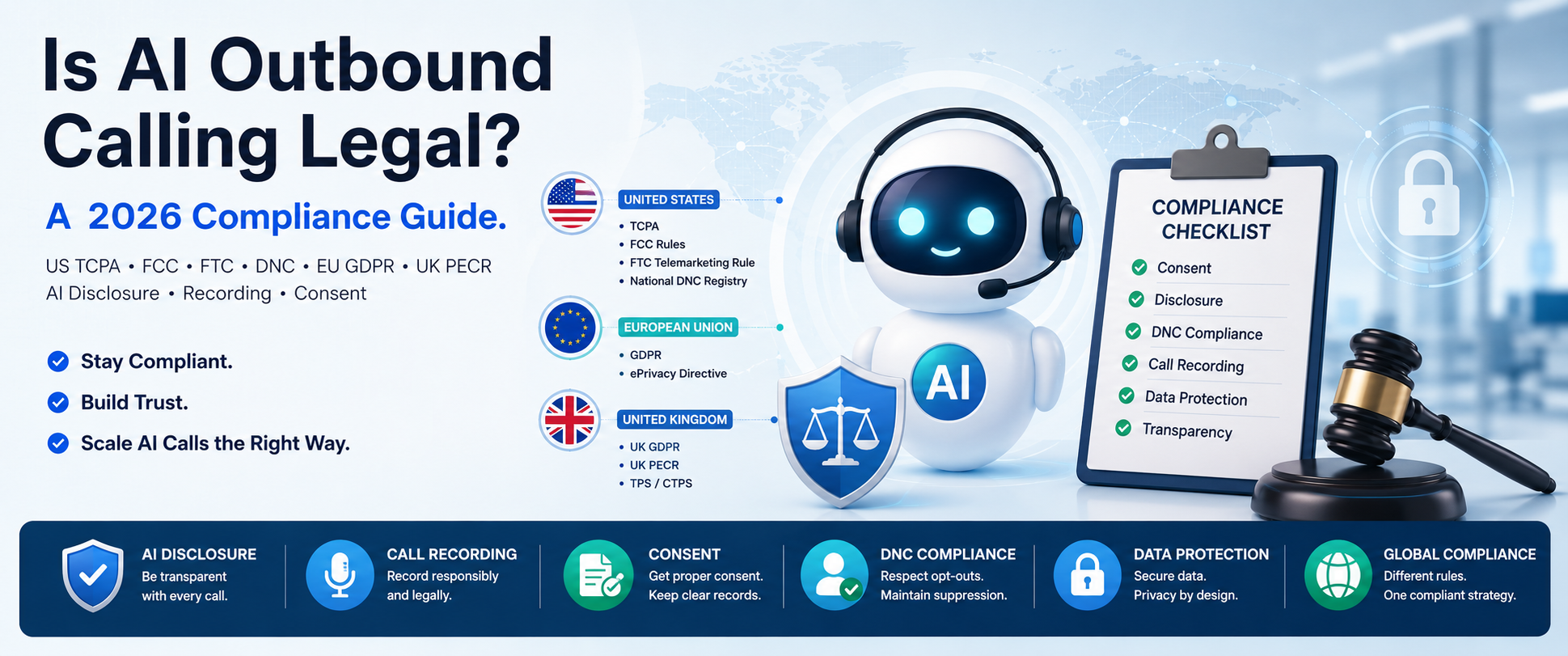
AI outbound calling has moved quickly from a technology experiment to a practical tool for sales, lead qualification, customer follow-ups, payment reminders, appointment scheduling, and notifications.
But there is one question that almost every business eventually asks:
Can we legally use an AI voice agent to make outbound calls?
The short answer is yes—but not simply because the call is made by AI.
The legal issue is usually not whether a company uses an AI voice agent. The real questions are:
- Who are you calling?
- Why are you calling?
- Is the call marketing, service-related, or informational?
- Is the voice AI-generated or prerecorded?
- Did the recipient consent?
- Is the number on a Do Not Call list?
- Are you recording the conversation?
- Where is the recipient located?
- How are call data and recordings stored?
- Can the recipient easily stop future calls?
These details can completely change the compliance requirements.
In the US, the FCC has confirmed that AI-generated human voices fall within the TCPA's restrictions on “artificial or prerecorded voice.” The FTC also continues to enforce its Telemarketing Sales Rule against unlawful robocalls and telemarketing practices.
In Europe and the UK, the picture is different again. GDPR, ePrivacy rules and UK PECR place particular importance on consent, transparency, data processing and the distinction between live calls and automated calls.
So the right question isn't:
It is:
“Under what conditions can we legally use AI outbound calling for this specific campaign?”
This guide explains how to think about that question in practical terms.
Important: This article is a practical compliance overview, not legal advice. Telecommunications and privacy rules vary by country, state, industry and campaign type. Before launching a large-scale campaign, businesses should have their specific workflow reviewed by qualified counsel.
1 First: AI Outbound Calling Is Not Automatically Illegal
There is a common misconception that regulators have “banned AI calling.”
That isn't an accurate way to look at the issue.
The FCC's 2024 ruling confirmed that AI-generated human voices are considered an “artificial or prerecorded voice” under the TCPA. That means an AI-generated voice does not escape existing robocall rules simply because the technology is newer.
This distinction matters.
Imagine two campaigns.
Campaign A — Appointment Reminder
A customer already booked an appointment.
The company uses an AI voice agent to call:
Campaign B — Cold Sales Call
A company purchases a database of consumer phone numbers and uses AI to call thousands of people:
This is very different from:
The second campaign creates substantially greater compliance risk.
The technology is similar.
The purpose, consent, audience and calling method are different.
That is why compliance should be designed around the campaign, not just the AI platform.
2 The Three Questions to Ask Before Launching Any AI Calling Campaign
Before discussing individual regulations, there is a simple framework that works well across markets.
Ask these three questions:
1. Who are we calling?
- Consumers?
- Existing customers?
- Business numbers?
- Employees?
- Leads who requested information?
- Purchased or third-party data?
2. Why are we calling?
- Sales?
- Lead qualification?
- Appointment reminder?
- Payment notification?
- Customer service?
- Fraud prevention?
- Account update?
3. What exactly is the call doing?
- Playing a prerecorded message?
- Using an AI-generated voice?
- Having a two-way conversation?
- Recording the call?
- Collecting personal information?
- Making decisions about the customer?
This simple classification prevents many compliance problems before they happen.
3 United States: The Rules You Need to Understand
For US campaigns, there isn't one single “AI calling law.”
You need to think about several overlapping frameworks.
The most important are:
- TCPA
- FCC rules
- FTC Telemarketing Sales Rule (TSR)
- National Do Not Call Registry
- State-specific telemarketing and privacy laws
The FCC and FTC regulate different aspects of telemarketing, and businesses should not assume compliance with one automatically means compliance with the other.
4 TCPA: The Starting Point for AI Voice Calls
The Telephone Consumer Protection Act, or TCPA, is one of the most important laws for automated outbound calling in the US.
The critical point for AI voice companies is the FCC's position that AI-generated voices fall within the TCPA's restrictions on artificial or prerecorded voices.
In other words:
Calling someone with an AI-generated voice does not make the call “human” for regulatory purposes.
This is especially important for sales campaigns targeting consumers.
For example:
High-risk scenario:
A company obtains 100,000 mobile numbers from a third-party data provider and launches an AI cold-calling campaign.
Even if the AI has a natural conversation and does not use a traditional prerecorded message, the campaign may still fall under TCPA restrictions applicable to artificial voice calls.
The fact that the AI can answer questions dynamically doesn't eliminate the underlying telemarketing requirements.
5 Consent: Don't Treat All Consent as the Same
One of the most important practical lessons in outbound calling is:
Suppose someone submits a form saying:
That may be useful evidence of an inquiry.
But you should not automatically assume that it authorizes every possible communication method, every company in your partner network, or unlimited AI-generated marketing calls.
For higher-risk automated telemarketing campaigns, businesses should maintain clear records showing:
- Who provided the number
- When consent was obtained
- What the person agreed to
- Which company received the consent
- What communication channel was covered
- Whether automated or AI calls were included
- How consent can be withdrawn
This is not just a legal exercise.
It becomes extremely useful when a customer complains:
Your team should be able to answer:
That is much stronger than:
6 Do Not Call: DNC Is Not Just a Database Feature
The National Do Not Call Registry is another important consideration for US telemarketing.
The FTC explains that telemarketers generally cannot call consumers who have registered their numbers on the National Do Not Call Registry, subject to applicable exceptions. The TSR also prohibits calls to consumers who have specifically asked a company not to call them.
This creates two separate operational concepts.
External DNC
The national Do Not Call Registry.
Internal DNC
Your company's own suppression list.
The second one is easy to underestimate.
Suppose a customer says:
Your AI should not simply finish the conversation and allow the number to remain in the next campaign.
The number should immediately move into a suppression workflow.
A good outbound system should therefore support:
This is much safer than asking agents to maintain spreadsheets manually.
7 DNC Does Not Mean Every Business Call Is Treated the Same
Another common mistake is assuming that every outbound call to every number is governed by exactly the same DNC rules.
The FTC notes that most business-to-business calls made to solicit sales from businesses are generally exempt from the federal TSR's DNC provisions, although important exceptions exist.
But this should not be interpreted as:
They aren't.
A business number can still belong to an individual.
State laws may apply.
Privacy laws may apply.
Industry-specific rules may apply.
And a recipient's direct request not to be contacted should still be respected.
For an international B2B campaign, the safest approach is to distinguish:
B2B business contacts
General organizational points of contact subject to corporate communication provisions.
Individual professionals
Individual professionals whose personal data is being used for marketing.
from
The second category can trigger additional privacy obligations.
8 FTC: The Telemarketing Sales Rule
The FTC Telemarketing Sales Rule (TSR) is another major part of US compliance.
The FTC says the TSR requires specific disclosures, prohibits misrepresentations, restricts calling times, prohibits calls to consumers who have asked not to be called, and establishes other telemarketing requirements.
The FTC also specifically addresses prerecorded-message telemarketing.
For example, a company shouldn't assume:
The FTC has long imposed restrictions on prerecorded telemarketing calls, and it continues to enforce rules against unlawful robocalling.
The practical takeaway is simple:
Don't design your campaign around finding a technical loophole between “AI voice,” “robocall,” and “prerecorded message.”
Design it around the customer's permission, the campaign purpose and the applicable rules.
9 Calling Time Matters
Even when a campaign is otherwise permitted, calling at the wrong time can create problems.
FCC consumer guidance states that telemarketing calls to a home are prohibited before 8 a.m. or after 9 p.m., subject to applicable rules and circumstances.
For an international AI calling campaign, this creates an important operational requirement:
Calling time should be calculated using the recipient's local time—not the call center's time.
Imagine your call center operates from Asia and launches a US campaign.
A campaign scheduled for:
could correspond to a completely different local time across US time zones.
A production-grade system should therefore maintain:
- Country
- State/region where relevant
- Time zone
- Allowed calling window
- Holiday restrictions
- Campaign-specific restrictions
The AI should not simply “call the list.”
It should first determine:
Is this number eligible to be called right now?
10 AI Disclosure: Should You Tell Customers They Are Speaking With AI?
This is one of the most interesting questions in 2026.
The answer needs some nuance.
The FCC has clearly stated that AI-generated voices are subject to TCPA treatment as artificial voices. The FCC also proposed additional rules concerning AI-generated calls, including disclosure requirements, but not every proposed measure should be treated as an already-final universal rule.
So businesses should distinguish between:
and
For most commercial AI calling campaigns, disclosure is a sensible approach.
For example:
Or:
11 A Practical AI Disclosure Example
This does several things:
- 1. It avoids misleading the recipient.
- 2. It creates transparency.
- 3. It reduces complaints such as “I thought this was a human.”
- 4. It establishes a clearer customer experience.
- 5. It prepares the business for increasingly strict AI transparency expectations.
The disclosure does not, by itself, make an otherwise unlawful call lawful.
That's an important distinction.
“We told them it was AI” does not replace consent.
Imagine a lead has requested a product demo.
A good opening might be:
This is considerably better than pretending:
when no human named John is actually speaking.
Transparency should be part of the customer experience, not something hidden in the fine print.
12 Call Recording: A Separate Compliance Question
A surprisingly common mistake is treating call recording as part of the same consent question as making the call.
They're related—but not identical.
A company may have permission to make a call and still need to consider separate requirements for recording or storing the conversation.
In the US, recording laws can vary by state.
Some jurisdictions are more restrictive about recording conversations without notice or consent from all relevant parties.
That creates a practical problem for national campaigns.
Imagine:
- Your company is in New York
- Your AI system is hosted elsewhere
- The customer is in California
- The call is recorded and transcribed
Which recording rules apply?
This is exactly why companies running large campaigns should not treat “recording enabled” as a simple platform setting.
13 The Safest Operational Approach to Recording
If the business does not have a clear legal basis for recording, one practical approach is to provide an early disclosure.
For example:
Depending on the jurisdiction and purpose, the wording and consent mechanism may need to be more specific.
For high-risk campaigns, legal review should determine whether notice alone is sufficient or whether affirmative consent is required.
And remember:
Recording is not the only data.
Your AI system may also generate:
- Transcripts
- Summaries
- Sentiment information
- Intent classifications
- Customer profiles
- CRM notes
- Call metadata
All of these may need to be considered as part of your data governance strategy.
14 EU: GDPR Is Only Part of the Picture
For European campaigns, one of the most important misconceptions is:
That is too simplistic.
Under GDPR, direct marketing may in some circumstances be based on legitimate interests. The EDPB has explicitly recognized that direct marketing can potentially qualify as a legitimate interest, but also stresses that this does not mean legitimate interest automatically works for every marketing activity.
And there is another layer:
ePrivacy rules can impose additional restrictions on electronic communications, including marketing calls.
So the analysis is generally:
- GDPR lawful basis
- Applicable ePrivacy/national telemarketing rules
- Transparency and data-subject rights
rather than simply:
15 GDPR: What AI Outbound Campaigns Need to Think About
If your AI calling campaign processes European personal data, you need to consider at least:
Lawful basis
Why are you allowed to process the person's data?
Transparency
Does the individual understand:
- Who you are?
- Why you're calling?
- Where you obtained their information?
- How their data is being used?
- Whether the call is recorded?
- Whether AI is involved?
Data minimization
Are you collecting information that is actually needed?
Retention
How long do you keep:
- Call recordings?
- Transcripts?
- AI summaries?
- Contact records?
Data subject rights
Can people:
- Access their information?
- Request correction?
- Object to direct marketing?
- Request deletion where applicable?
The EDPB emphasizes transparency and the obligation to stop direct marketing when an individual objects.
16 GDPR and AI Call Recordings
Call recordings and transcripts can become personal data.
The EDPB specifically notes that telephone recordings and their transcriptions can fall within the scope of personal data subject to access rights.
This has an important practical implication.
Suppose your AI agent talks to 50,000 customers.
You store:
You now have a large collection of customer interaction data.
The compliance question isn't simply:
It becomes:
“Do we have an appropriate legal basis and governance framework for everything we do with the information generated by that call?”
That's a much more useful way to think about AI compliance.
17 EU Marketing Calls: Don't Ignore Local Rules
The EU does not operate as though every country has exactly the same telemarketing implementation.
The ePrivacy framework interacts with national laws and local enforcement.
This means a company planning:
should not assume:
Instead, create country-level rules for:
- Consent
- Marketing calls
- Automated calls
- Recording
- DNC/opt-out
- Calling hours
- Privacy notices
This is especially important for large-scale multilingual campaigns.
18 UK: PECR Changes the Analysis
The UK has a particularly important distinction between live marketing calls and automated marketing calls.
Under PECR, most live marketing calls do not require prior consent in every situation, but organizations generally must respect the Telephone Preference Service (TPS) and Corporate Telephone Preference Service (CTPS) rules.
Automated marketing calls are much stricter.
The ICO states that automated marketing calls using an autodialling system that plays a recorded message require the recipient's consent. Consent for general marketing, or consent for live marketing calls, is not enough.
This distinction is extremely important for AI voice companies.
19 UK PECR: AI Voice Calls Need Careful Classification
Suppose a company calls UK consumers with an AI voice agent.
The first question should be:
Is this effectively an automated marketing call?
If the campaign is marketing-related and uses an automated calling system, the organization needs to carefully assess the PECR requirements rather than assuming that “AI is conversational, so it counts as a live call.”
The ICO's guidance is clear that automated marketing calls have stricter requirements than live marketing calls.
This is one of the areas where companies should be particularly cautious about relying on technical definitions.
20 UK TPS and CTPS
For live UK marketing calls, businesses should screen their calling lists against:
- TPS — Telephone Preference Service
- CTPS — Corporate Telephone Preference Service
The ICO states that organizations must not make live marketing calls to numbers registered with these services unless the subscriber has specifically consented to receiving those calls.
This should happen before dialing, not after a complaint.
A practical workflow is:
This is far safer than:
21 UK Consent Needs to Be Specific
The ICO recommends keeping clear records of what a person consented to, when they consented and how the consent was obtained.
For example, this is weak:
This leaves too many questions.
A stronger consent record might identify:
And if the campaign involves automated or recorded calls, the consent should be assessed against the specific requirements that apply to that communication.
The ICO also warns that consent to one purpose does not automatically extend to another.
22 Third-Party Lead Lists Are a Major Risk Area
This is one of the most practical issues for outbound sales teams.
A company buys:
The vendor says:
That statement should never be the end of your compliance review.
You need to know:
- Where were the numbers collected?
- What did the individual consent to?
- Was consent given to your company?
- Was consent transferable?
- Did the consent cover telephone marketing?
- Did it cover automated calls?
- Was the identity of the caller disclosed?
- When was consent obtained?
- Can the supplier provide evidence?
The ICO specifically advises businesses to check the origin and accuracy of purchased lists and to ensure the required consent exists for recorded calls and other marketing channels.
A cheap lead list can become an expensive compliance problem.
23 A Real-World Example: The Wrong Way to Launch an AI Campaign
Imagine an e-commerce company wants to recover abandoned purchases.
The company has 500,000 phone numbers from several sources.
The marketing team decides:
The system immediately starts calling.
Within a few days:
- Some numbers belong to people who never opted in
- Some are on DNC lists
- Some belong to people who previously opted out
- Some contacts are outside allowed calling hours
- Some calls are recorded without proper notice
- Some customers ask not to be contacted again
- The suppression list isn't updated quickly
The technology may work perfectly.
The campaign is still poorly designed.
24 A Better Compliance-First Workflow
A better approach looks like this:
This process may look slower at the beginning.
In practice, it prevents much bigger problems later.
25 What an AI Outbound Platform Should Handle Automatically
Compliance shouldn't depend entirely on sales managers remembering a checklist.
A mature AI outbound platform should be capable of enforcing campaign rules before a call is placed.
Important capabilities include:
Consent Management
Store:
- Consent status
- Consent source
- Timestamp
- Consent type
DNC Management
Automatically suppress numbers after:
Local Time Controls
Prevent calls outside permitted windows.
Campaign Rules
Different campaigns should have different rules. For example:
US Consumer Sales Campaign may have very different requirements from: UK Existing Customer Reminder Campaign.
AI Disclosure
Allow campaign-level opening scripts such as:
Recording Controls
Allow recording to be enabled or disabled based on campaign requirements.
Audit Logs
Keep evidence of:
- Who was called
- When
- Why
- Consent status
- Campaign
- DNC status
- Outcome
- Opt-out request
These features are not just “nice to have” for enterprise customers.
They can become an important part of the operational compliance model.
26 What Should Happen When a Customer Says “Stop Calling Me”?
This is one of the simplest tests of an outbound system.
A poorly designed system:
Then the customer receives another call tomorrow.
A better system:
This should happen automatically.
27 Compliance Is Also About Data Retention
Another issue that receives too little attention is:
How long are you keeping the conversation?
Suppose your AI platform stores every call forever.
Over time, the company accumulates:
- Millions of recordings
- Millions of transcripts
- Customer names
- Phone numbers
- Purchase information
- Payment discussions
- Intent classifications
The question becomes:
A sensible retention policy should be tied to the actual business purpose and applicable legal requirements.
For example:
- Raw audio: shorter retention
- Transcript: longer if required
- CRM outcome: retained according to customer lifecycle requirements
There is no universal “AI call recording retention period” that works for every business.
The right period depends on the purpose, jurisdiction, industry and applicable legal obligations.
28 Compliance Doesn't Mean Making Every AI Call Sound Robotic
One concern sometimes raised by businesses is:
That depends heavily on how the disclosure is designed.
Compare:
Robotic & Legalistic
Conversational & Natural
The second is much more natural.
Compliance should not mean creating a poor customer experience.
The objective is:
Transparent + Clear + Conversational
rather than:
29 A Practical 2026 Compliance Checklist
Before launching an AI outbound campaign, ask:
🇺🇸 United States
🇪🇺 EU
🇬🇧 UK
🤖 AI
30 The Most Important Principle: Compliance Should Be Built Into the Workflow
AI outbound calling can dramatically increase the number of conversations a company can handle.
That is exactly why compliance cannot be an afterthought.
If a human sales representative makes 30 calls per day, a process failure may affect 30 customers.
If an AI system makes 30,000 calls per day, the same process failure can affect 30,000 customers.
Automation magnifies both efficiency and mistakes.
The answer is not to avoid AI.
The answer is to build the compliance controls into the calling workflow itself.
A mature AI outbound strategy should therefore look like:
rather than:
Final Thoughts: Is AI Outbound Calling Legal in 2026?
Yes.
But AI outbound calling is not a compliance shortcut.
The fact that a voice agent can have a natural conversation does not remove telemarketing, consent, DNC, privacy or recording obligations.
In the US, the FCC has made clear that AI-generated voices fall within TCPA restrictions applicable to artificial or prerecorded voices. The FTC continues to enforce telemarketing and robocall restrictions.
In the EU, businesses need to consider GDPR together with applicable ePrivacy and national rules. Direct marketing may sometimes rely on legitimate interest under GDPR, but that does not automatically remove separate electronic-communications requirements.
In the UK, PECR creates a particularly important distinction between live marketing calls and automated marketing calls, with automated marketing calls subject to stricter consent requirements.
For businesses, the practical lesson is straightforward:
Don't ask whether AI calling is legal in general. Ask whether your specific campaign is compliant.
The strongest AI outbound programs are not simply the ones that make the most calls.
They are the ones that can answer, for every call:
- Why did we call this person?
- Were we allowed to call them?
- What did they consent to?
- Did they ask us to stop?
- What did we record?
- What data did the AI create?
- And can we prove what happened?
That's what turns AI outbound calling from a high-volume automation tool into an enterprise-ready communication channel.
Key Takeaway
AI doesn't change the need for compliance. It changes the scale at which compliance must work.
For businesses evaluating an AI outbound call center in 2026, compliance should therefore be treated as part of the product architecture—not as a document prepared after the campaign has already started.
Regulations can change, and country/state requirements can differ. This guide is intended for educational purposes and should not replace jurisdiction-specific legal advice.
Official references
- The FCC's current consumer guidance states that AI-generated voice calls are subject to the robocall framework and highlights the need for consumer agreement in applicable circumstances.
- The FTC's current Telemarketing Sales Rule guidance covers telemarketing disclosures, calling restrictions, Do Not Call requirements and prerecorded-message rules.
- The ICO's current guidance covers UK telephone marketing, TPS/CTPS screening and the stricter rules applicable to automated marketing calls.
- The EDPB's guidance explains how legitimate interests can apply to some direct-marketing processing while emphasizing that this is not an automatic basis for every marketing activity.


