

How AI Outbound Calling Automates Customer Follow-Up
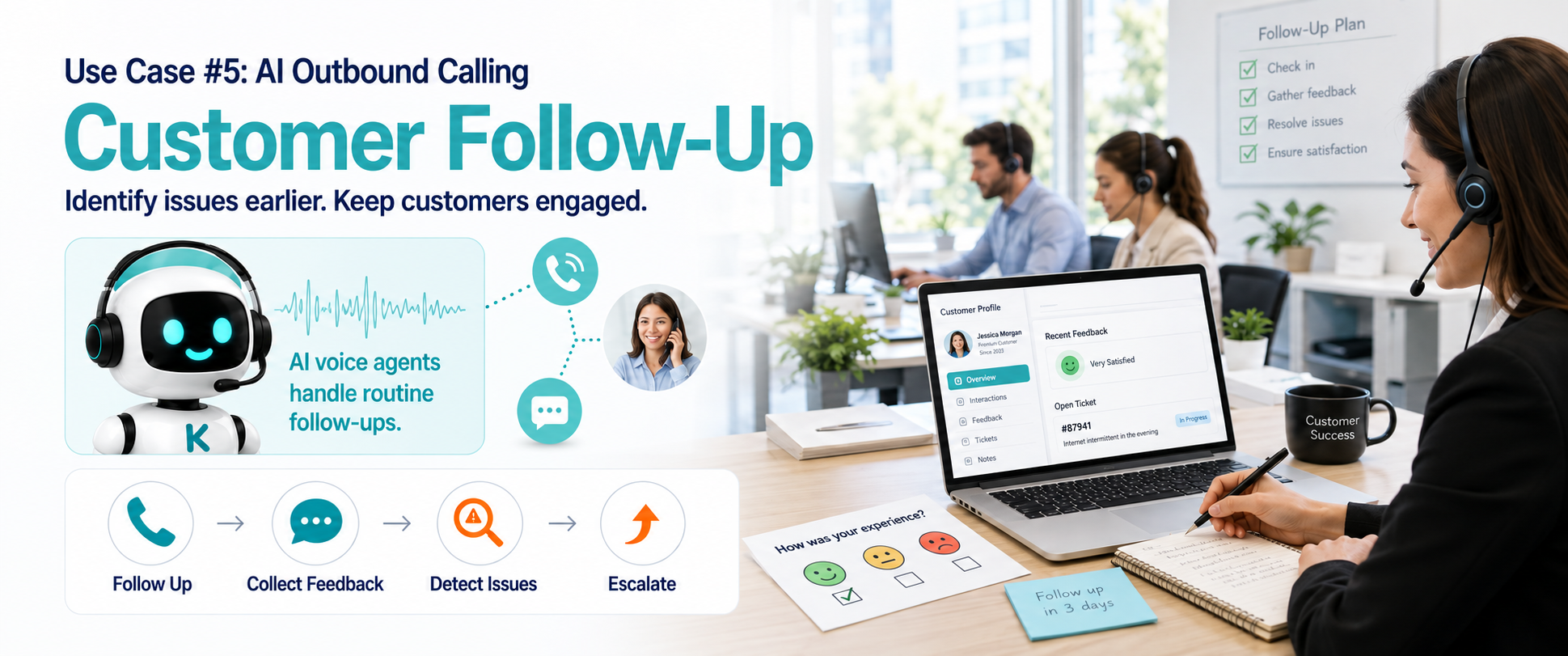
Don't Let Important Customer Conversations End After the First Interaction
A sale is completed. A service request is closed. A product is delivered.
But the customer journey doesn't end there.
For many businesses, what happens after an interaction can be just as important as the interaction itself.
The challenge is scale.
When hundreds or thousands of customers require follow-up, it becomes difficult for customer service teams to call everyone manually.
This is where AI outbound calling can help.
AI voice agents can automatically follow up with customers, collect feedback, identify unresolved issues, and escalate customers who need human assistance.
Why Customer Follow-Up Often Gets Missed
Most businesses understand the value of following up with customers.
The problem is that follow-up calls are often repetitive and time-consuming.
Agents may need to work through long customer lists, make similar calls, ask the same questions, record responses, and decide whether further action is required.
When teams become busy, these calls are often delayed—or never made at all.
As a result, businesses may miss important signals:
AI outbound calling makes it possible to follow up more consistently without adding the same level of manual workload.
How AI Outbound Calling Works for Customer Follow-Up
AI voice agents can automatically trigger calls after specific customer events, such as a purchase, delivery, service appointment, support interaction, or closed ticket.
During the call, AI can:
Confirm whether a product or service was successfully received
Check whether an issue has been resolved
Ask predefined customer satisfaction questions
Collect feedback through natural voice conversations
Identify complaints or negative sentiment
Answer common follow-up questions
Record and categorize customer responses
Update CRM or customer service systems
Escalate customers who need additional assistance to human agents
For example:
“Hi Emma, we're following up on your recent service request. Has your issue been fully resolved?”
“Yes, everything is working now.”
The AI can record the case as successfully resolved and complete the follow-up.
But if the customer says:
“No, I'm still having the same problem.”
The AI can identify the unresolved issue, capture relevant information, and trigger a human follow-up.
Instead of waiting for the customer to contact the business again, the business can take action proactively.
Turn Customer Follow-Up into an Automated Workflow
The real value of AI outbound calling isn't simply making more follow-up calls.
It's connecting those conversations to the next action.
Depending on the response, different workflows can be triggered:
This turns customer follow-up from a repetitive calling task into a scalable customer experience process.
One Use Case, Many Customer Journeys
AI-powered customer follow-up can be applied across many industries and scenarios.
Follow up after purchases or deliveries and collect customer feedback.
Check in with patients after appointments or services.
Follow up after maintenance, repairs, or vehicle delivery.
Check customer satisfaction after applications, claims, or service requests.
Confirm that services were completed successfully and identify additional needs.
Automatically follow up after tickets are closed to confirm that the issue was actually resolved.
Wherever businesses need to reconnect with customers after an interaction, AI outbound calling can help make that follow-up more consistent.
The Goal Isn't More Calls. It's Fewer Customers Falling Through the Cracks.
Customer follow-up shouldn't be measured simply by how many calls are completed.
The more important questions are:
AI handles the repetitive follow-up.
Human agents focus on customers who actually need empathy, judgment, and problem-solving.
Follow up automatically.
Identify issues earlier.
Keep more customers engaged.
With Kontactix AI Outbound Calling, businesses can automate post-service follow-ups, collect customer feedback, identify unresolved issues, update customer records, and escalate important conversations to human agents—helping ensure that valuable customer interactions don't get missed.


