

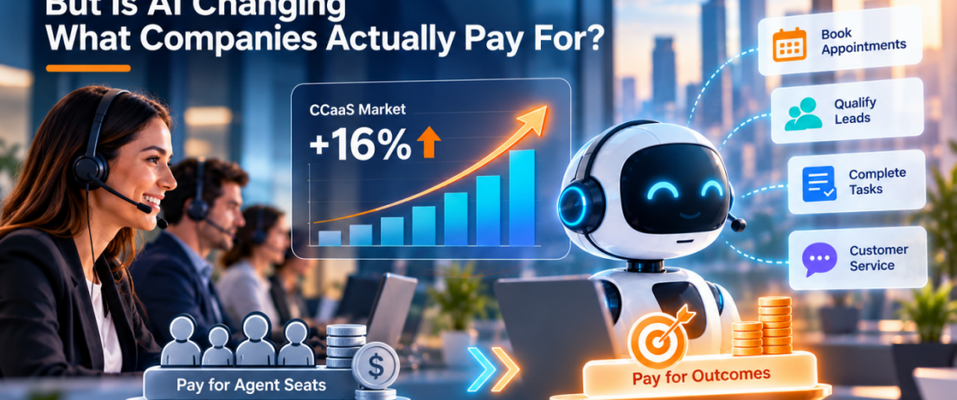
The contact center market is growing. But the way businesses measure its value may be changing even faster.
For years, contact center software followed a relatively straightforward business model.
Companies paid for agent seats, phone systems, call routing, reporting tools, and additional features.
More agents usually meant more licenses. More customers meant more calls, more staffing, and often higher operating costs.
Now, AI is challenging that equation.
As AI voice agents become capable of handling conversations, qualifying leads, scheduling appointments, and completing routine customer service tasks, businesses are beginning to ask a different question:
Why pay primarily for the number of agents when what really matters is the work being completed?
1 CCaaS Is Still Growing — But the Market Is Changing
The Contact Center as a Service (CCaaS) market continues to expand.
According to Metrigy's 2026 CCaaS market research, global CCaaS revenue reached approximately $8.4 billion in 2025, growing 16% year over year.
The market is projected to reach approximately $13.3 billion by 2030.
Meanwhile, traditional on-premises contact center platforms are facing increasing pressure as businesses continue migrating toward cloud-based solutions.
These numbers tell us something important:
Contact centers aren't disappearing. They're evolving.
Cloud migration remains a major growth driver. But the next phase of competition may be less about moving traditional call center functions to the cloud and more about embedding AI into customer interactions and business workflows.
For CCaaS providers, this creates both an opportunity and a challenge.
AI can create new revenue streams, but it may also reduce demand for some traditional agent-based licenses.
2 The Traditional Model: Pay for Agent Capacity
Historically, contact center platforms have often been priced around human agent capacity.
A business with 50 agents might purchase 50 licenses.
If the business grows to 100 agents, software spending typically increases.
This model makes sense when human agents handle most customer interactions.
But consider a different scenario.
A company receives 10,000 customer inquiries every month. Previously, it needed a large team to answer repetitive questions, confirm appointments, and follow up with customers.
Now, AI voice agents can potentially handle a meaningful share of those routine interactions.
The company may still serve 10,000 customers, or even more, without increasing its human agent count proportionally.
Suddenly, the number of agent seats becomes a less complete measure of the value delivered by the contact center.
This doesn't mean seat-based pricing will disappear.
Human agents will remain essential for complex conversations, exceptions, relationship management, and situations requiring judgment.
But it does suggest that the relationship between customer interaction volume, software revenue, and human headcount is changing.
3 AI Is Introducing New Ways to Pay
As AI becomes more deeply integrated into contact center operations, three pricing approaches are becoming increasingly relevant.
Per-Agent Pricing
The traditional model charges businesses based on the number of human agents using the platform.
It remains practical for workforce management, agent desktops, supervision, and human-assisted customer service.
Usage-Based Pricing
Many AI voice platforms charge based on usage, such as conversation minutes, API consumption, or other processing resources.
This approach can better reflect the amount of AI activity.
However, a longer conversation doesn't necessarily mean a better outcome.
A five-minute call that fails to solve a customer's problem may cost more than a two-minute call that successfully completes the task.
Outcome-Based Pricing
A third approach is to connect pricing more closely to measurable business results.
For example:
- A qualified sales lead
- A confirmed appointment
- A successfully completed customer follow-up
- A resolved routine service request
- A completed renewal confirmation
This approach is attractive because it connects technology spending to business value.
But outcome-based pricing also introduces challenges.
What counts as a successful outcome? How should quality be measured? And how much of the result can reasonably be attributed to the AI system?
These questions matter, especially for complex customer interactions.
The likely future may not be one universal pricing model, but a combination of agent licenses, AI usage, and performance-related metrics.
4 AI Outbound Calling Makes This Shift Easier to See
Outbound calling provides a particularly clear example.
Traditional outbound contact centers often measure operational performance through:
- Number of agents
- Calls attempted
- Talk time
- Calls per agent
- Cost per call
These metrics are useful for managing capacity.
But they don't always explain whether the business is achieving its goals.
Imagine two outbound campaigns.
Campaign A
A human team makes 5,000 calls and generates 150 qualified leads.
Campaign B
AI voice agents make 20,000 calls and generate 500 qualified leads, with human agents handling interested prospects and complex conversations.
These are hypothetical examples, not reported campaign results.
Campaign B produces more qualified leads in absolute terms, but it also requires four times as many call attempts. Its qualification rate is lower.
To determine which campaign performs better, the business would need to compare the total campaign cost, lead quality, conversion rates, customer experience, and downstream sales outcomes.
The point isn't simply that AI can make more calls.
It's that AI changes how businesses can scale customer engagement — and what they should measure to evaluate success.
For AI outbound calling, the most meaningful metrics may increasingly include:
- Cost per qualified lead
- Cost per confirmed appointment
- Conversion rate
- Revenue generated per campaign
- Human time saved
- Customer experience and compliance performance
Instead of asking how many agents are available, businesses can focus more directly on how effectively their outreach generates results.
5 The Bigger Shift: From Conversations to Actions
Another important change is happening beneath the pricing model.
Traditional contact center software was primarily designed to help people manage customer conversations.
AI-powered contact centers are increasingly being designed to help complete the work behind those conversations.
Consider a customer calling to reschedule an appointment.
A traditional system routes the call to an agent.
A basic AI chatbot might explain how rescheduling works.
An AI agent connected to business systems could potentially:
The value isn't just the conversation.
It's the completed workflow.
This is where Agentic AI, CRM integration, and CCaaS are beginning to converge.
And it creates an important distinction between AI that simply communicates and AI that can reliably execute business tasks.
6 What Does This Mean for CCaaS Providers?
The transition creates several strategic questions for traditional contact center vendors.
First, can AI revenue offset potential pressure on agent-seat growth?
If businesses automate more routine interactions, some may need fewer incremental human agent licenses. Vendors will need to capture value through AI services, orchestration, analytics, and other capabilities.
Second, who owns the customer workflow?
Contact center platforms, CRM providers, and AI agent vendors are increasingly competing and collaborating around the same business processes.
The platform that connects conversations with customer data and business actions may become particularly valuable.
Third, how will enterprises evaluate ROI?
Automation rates alone won't be enough.
Businesses will also need to measure task completion, resolution quality, escalation rates, total cost, and customer satisfaction.
And finally, reliability matters.
An AI agent that handles routine conversations well but fails during complex scenarios may create additional work rather than reduce it.
Successful automation requires clear business rules, reliable integrations, monitoring, and smooth handoffs to human teams.
7 The Future of CCaaS May Be About Outcomes, Not Seats
The CCaaS market is growing, and AI could create significant new opportunities for both established vendors and emerging providers.
But growth in the overall market doesn't necessarily mean every traditional revenue model will continue growing at the same rate.
Businesses will still need contact center infrastructure, communication channels, analytics, compliance controls, and human agents.
What may change is how they decide what those capabilities are worth.
For AI voice agents, especially in outbound calling, the conversation is gradually shifting:
The future of CCaaS is unlikely to be entirely seat-based or entirely outcome-based.
But one thing is becoming clear:


