

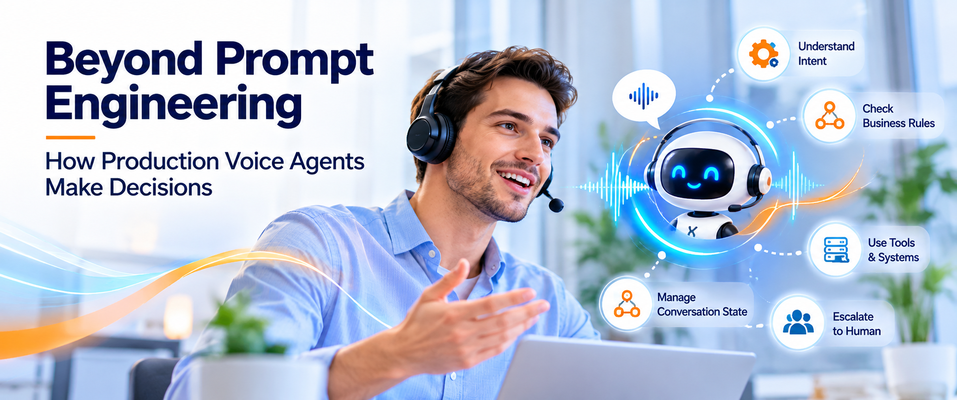
Why reliable AI voice agents need more than a good prompt—and how decision engines, state machines, tool calling, and business rules work together.
★ Introduction: A Good Prompt Doesn't Make a Reliable Voice Agent
You can build an impressive AI voice agent with a well-written prompt.
Give it a role, a goal, some instructions, and access to a language model. Within minutes, it can answer questions, qualify leads, and hold surprisingly natural conversations.
But what happens when a customer changes their mind halfway through a call?
Or asks the AI to reschedule an appointment, only to discover that the requested time is unavailable?
What if the customer requests a refund that exceeds the company's approval limit?
These are not simply language-generation problems.
In a production contact center, an AI voice agent must do more than understand what a customer says. It must determine what actions are appropriate, which systems to access, when to ask for clarification, and when to transfer control to a human.
That requires an architecture extending far beyond prompt engineering.
01 1. Why Prompt Engineering Alone Isn't Enough
A prompt defines how an AI agent should behave.
For example:
This works reasonably well for simple conversations.
However, prompts have an important limitation: they influence model behavior but do not independently enforce business rules.
Consider a customer saying:
A language model might generate a persuasive response. But should it actually waive the cancellation fee?
That decision may depend on:
- The customer's account status
- The company's cancellation policy
- Previous exceptions
- The agent's authorization level
- Whether human approval is required
The model can help interpret the request, but it should not have unrestricted authority to make the decision.
A useful engineering principle is to separate conversational intelligence from operational authority.
The LLM determines what the customer is asking and proposes an appropriate next step.
The application decides whether that step is permitted.
02 2. Inside a Production Voice Agent Architecture
A production voice agent typically combines several components.
Real-Time Voice Processing
The system receives audio, identifies speech boundaries, and converts speech into information the decision engine can process. Depending on the architecture, this may involve:
Speech-to-speech models may combine some of these functions, but the system still needs mechanisms for controlling external actions.
Conversation State Management
The system tracks where the conversation stands. For example:
This prevents the agent from treating every customer response as an independent request.
Decision Engine
The decision engine evaluates the current state, customer intent, available information, and permitted actions. It may combine:
Business System Integration
The agent interacts with external systems through controlled interfaces. Examples include:
Governance and Monitoring
The final layer determines what the agent is allowed to do and records what happened.
It includes authorization, validation, audit logs, error handling, and human escalation.
03 3. State Machines: Giving AI Conversations Structure
One of the most practical techniques for controlling production voice agents is the use of state machines.
A state machine represents a conversation as a set of defined states and transitions.
Consider an AI outbound agent calling a potential customer to schedule a product demonstration.
A simplified workflow might look like this:
But real conversations are rarely linear.
The customer might say:
The agent should transition from qualification to callback scheduling rather than continuing to ask qualification questions.
Or the customer might say:
The agent should recognize the change and end the sales workflow appropriately.
A state machine helps maintain this structure.
However, rigid state machines can also become problematic.
Customers frequently interrupt, ask unrelated questions, or change topics.
A production architecture therefore often benefits from a hybrid approach:
LLMs interpret flexible language, while state machines control important workflow transitions.
For example, the LLM may classify a response as a callback request, but the application verifies that the callback time is valid before updating the workflow.
This approach combines conversational flexibility with predictable execution.
04 4. Tool Calling: Turning Conversations into Actions
Understanding customer intent is only the first step.
A useful AI voice agent must often perform actions.
Suppose a customer says:
The agent needs to:
- Identify the customer and the relevant appointment.
- Check available time slots.
- Confirm the customer's preferred time.
- Update the appointment.
- Communicate the result.
This is where function calling, also known as tool calling, becomes essential.
Instead of inventing an answer, the language model requests an operation from an external system.
For example:
{
  "tool": "check_appointment_availability",
  "arguments": {
    "date": "2026-11-06",
    "time_period": "afternoon"
  }
}
The application validates the arguments and executes the request.
The scheduling system returns available slots, and the AI presents them to the customer.
Once the customer confirms a specific slot, the application can perform the booking.
- The scheduling system determines actual availability.
- The application verifies authorization.
- The agent communicates the confirmed outcome.
This distinction becomes especially important when actions involve payments, account modifications, or sensitive customer information.
05 5. Business Rules: What the AI Is Allowed to Decide
Not every decision should be delegated to a language model.
Some decisions require deterministic rules.
Consider a payment reminder agent.
The AI can explain an outstanding balance, answer questions, and identify whether the customer intends to pay.
But suppose the customer asks:
The agent should not negotiate beyond its permitted authority.
A production decision engine might implement rules such as:
| Situation | Decision |
|---|---|
| Customer requests payment information | Retrieve verified account details |
| Customer asks about available payment methods | Provide approved options |
| Customer disputes the outstanding balance | Escalate to the appropriate team |
| Customer requests an unauthorized discount | Explain limitations or request human approval |
| Customer asks to stop receiving calls | Record the opt-out and terminate the outreach workflow |
These rules should be enforced outside the prompt wherever possible.
This creates a clear separation between what the AI can discuss and what it can execute.
It also makes the system easier to audit, test, and update when business policies change.
06 6. Handling Uncertainty and Unexpected Conversations
Production voice agents operate in unpredictable environments.
Customers may speak with strong accents, use ambiguous language, interrupt frequently, or provide incomplete information.
An AI agent must recognize when it does not have enough information to proceed.
Consider the response:
Does the customer mean they agree to the appointment time, the quoted price, or a callback?
The correct interpretation depends on the conversation state.
A reliable decision engine should evaluate:
- Context: What question was the customer answering?
- Required Information: Are all necessary parameters available?
- Action Risk: What happens if the interpretation is wrong?
- Confirmation Requirements: Does the action require explicit customer approval?
For low-risk interactions, the agent may proceed with minimal clarification.
For higher-risk actions, it should request confirmation.
For example:
This is more reliable than allowing the model to infer consent from an ambiguous response.
Confidence scores can help, but they should not be treated as guarantees of correctness. Model-generated confidence is not necessarily calibrated, and production systems should use task-specific validation and uncertainty policies.
07 7. Human Handoff Is Part of the Decision Architecture
A common misconception is that an advanced AI agent should handle every conversation independently.
In practice, deciding when not to automate is an important capability.
Human escalation may be triggered when:
- The customer explicitly requests a human.
- The requested action exceeds the AI's authority.
- The conversation involves a sensitive dispute.
- Required information cannot be verified.
- A critical external system becomes unavailable.
- The agent repeatedly fails to resolve the request.
A well-designed handoff should transfer more than the phone call.
The human agent should receive relevant context, such as the customer's verified identity, the reason for the call, information already collected, and actions attempted.
This avoids forcing customers to repeat the entire conversation.
For AI outbound calling, this is particularly valuable during lead qualification.
The AI can identify interest, collect requirements, and determine whether a prospect meets predefined criteria.
When the customer is ready for detailed negotiation, the system can transfer the conversation to a salesperson with the relevant context.
The objective is not to eliminate human involvement. It is to reserve human expertise for decisions and interactions where it adds the most value.
08 8. The Engineering Challenge: Making Decisions in Real Time
Decision-making becomes more complicated when it happens during a live phone call.
A chatbot can take several seconds to retrieve information without completely disrupting the experience.
A voice agent operates under tighter conversational expectations.
Each additional step may introduce latency:
Independent operations can sometimes execute concurrently. For example, retrieving customer information and checking available appointment slots may run in parallel when their inputs are already known.
Frequently accessed, non-sensitive reference information can be cached to reduce repeated requests. However, transactional data such as appointment availability or account balances may require fresh verification.
External tools should have explicit timeout policies. If a scheduling service becomes unavailable, the agent should not invent a booking confirmation. It can instead explain the limitation, offer a callback, or transfer the customer to a human.
Unrestricted tool-calling loops can increase latency and cost. Production systems should limit repeated tool calls, enforce execution budgets, and detect unproductive decision cycles.
External API calls can become particularly expensive in terms of response time.
For example, a CRM lookup may depend on network conditions, database performance, and authentication services.
Production systems need strategies to control these delays.
09 9. Real-World Example: AI Outbound Lead Qualification
Consider a real estate company using AI outbound calling to follow up with new inquiries.
The AI agent's objective is to identify interested buyers and schedule property viewings.
A simplified workflow could include:
The AI introduces the purpose of the call and verifies that the customer is willing to continue.
The agent asks about location preferences, budget, property type, and purchase timeline.
The system evaluates whether the lead meets predefined qualification criteria.
Depending on the customer's response:
- Qualified and interested → Check viewing availability.
- Interested but unavailable → Schedule a callback.
- Needs detailed negotiation → Transfer to a salesperson.
- Not interested → Record the outcome and end the workflow.
- Requests no further contact → Record the opt-out and suppress future outreach as required.
The system records structured results, such as qualification status, customer preferences, next action, and call outcome.
The critical point is that the AI does not independently invent the sales workflow.
- The LLM interprets the conversation.
- The decision engine applies business logic.
- External tools execute authorized actions.
- The CRM stores the resulting business data.
This architecture allows companies to automate repetitive interactions while maintaining control over important decisions.
10 10. How to Evaluate a Production Voice Agent
When evaluating an AI voice agent platform, enterprises should look beyond conversation quality.
A natural-sounding voice is important, but it does not guarantee operational reliability.
Key evaluation questions include:
| Area | What to evaluate |
|---|---|
| Conversation Management | Can the agent handle interruptions and changes in customer intent? |
| Workflow Control | Are important state transitions explicitly managed? |
| Tool Integration | Can external actions be validated and audited? |
| Business Rules | Can the system enforce permissions outside the prompt? |
| Error Handling | What happens when an API fails or returns unexpected data? |
| Human Escalation | Can the agent transfer context to a human? |
| Observability | Can engineers reconstruct why an action was taken? |
| Testing | Can the system be evaluated against realistic conversation scenarios? |
Testing should include more than successful conversations.
Teams should deliberately test ambiguous responses, contradictory instructions, unavailable services, invalid customer information, and attempts to bypass business rules.
A particularly useful metric is authorized task completion rate: the proportion of eligible tasks completed correctly without violating business rules.
This is often more meaningful than simply measuring how many conversations the AI handled.
Conclusion: The Future of Voice AI Is Controlled Autonomy
Prompt engineering remains an important part of building AI voice agents.
But prompts alone are not enough to operate reliably in real business environments.
Production systems require a combination of language understanding, structured workflows, deterministic business rules, controlled tool execution, and human oversight.
The most important architectural principle is straightforward:
As voice AI moves from demonstrations into enterprise contact centers, the focus will increasingly shift from how naturally an agent speaks to how reliably it makes and executes decisions.
The next generation of AI voice agents will not be defined simply by their ability to hold conversations.

